
The Road to Prevent: What We Learn Along the Way Matters

Some of the most important work in school safety happens long before a safety concern is identified. It happens when a principal makes time to connect with a student who has started pulling away. It happens when a teacher trusts their instincts enough to share a concern. It happens when a counselor, administrator, law enforcement partner, and mental health professional sit around the same table and realize they have each seen a different piece of the same story.
I have spent years working alongside people who are deeply committed to making schools safer, and one thing has become increasingly clear to me: we do not build stronger prevention practices simply by having the right answers. We build them by continuing to learn how to ask better questions.
That is the thinking behind the Road to Prevent.
Rather than viewing professional development as a series of isolated events, the Road to Prevent creates opportunities to keep learning, connecting, and building on what came before. Each stop offers a different perspective on school safety and prevention, but the larger purpose is the same: to help the people responsible for protecting and supporting students bring new knowledge back to their schools and communities.
Because when it comes to prevention, the journey matters.
The Work Keeps Evolving
School safety is not a field where we can learn everything we need to know and then move on. The needs of our students evolve. Technology changes how young people communicate and how concerning behavior can surface. Research continues to shape our understanding of violence prevention. Schools experience turnover, encounter new challenges, and learn from experiences that inevitably change the way we think about the work. That means our professional learning cannot remain static, either.
An effective school safety professional today may need to understand behavioral threat assessment and management, student mental health, digital behavior, emergency preparedness, school climate, crisis response, and the importance of multidisciplinary collaboration. No one person can be an expert in all of it, nor should we expect them to be.
What we can expect is a willingness to keep learning. That might mean strengthening a skill you already have. It might mean learning about an area that falls outside your traditional role. Or it might mean hearing a perspective that causes you to reconsider something you thought you understood.
Those moments are valuable because prevention is rarely about finding a single perfect solution. More often, it is about developing the knowledge and relationships that allow us to recognize an opportunity to intervene and respond thoughtfully when that opportunity arises.
We Are Better When We Learn Together
One of the things I value most about this field is how many different disciplines contribute to the work.
Educators understand the daily realities of the school environment. Mental health professionals bring critical expertise about student needs and behavior. Law enforcement partners bring another perspective on safety and community response. Administrators have to think about systems, resources, policy, and implementation. Families and students bring experiences that no professional can replicate.
None of those perspectives tells the whole story. Together, however, they can help us see more of the picture. That is one reason gathering together to learn matters beyond the content on the agenda. It creates space for people who may not normally work side by side to compare experiences, ask questions, and build relationships.
When we know one another before a difficult situation arises, collaboration becomes more natural. When we understand one another's roles, we are better equipped to recognize where our responsibilities intersect. And when we have built a culture of learning together, it becomes easier to acknowledge what we do not know and seek help when we need it.
Multiple Stops – One Destination
There is no single way to participate in the Road to Prevent, because there is no single path to becoming better prepared.
For some professionals, the journey may begin with foundational learning about behavioral threat assessment and management. For others, it may mean exploring comprehensive school safety, hearing from national experts, connecting with peers, or going deeper into the complex issues shaping prevention today.
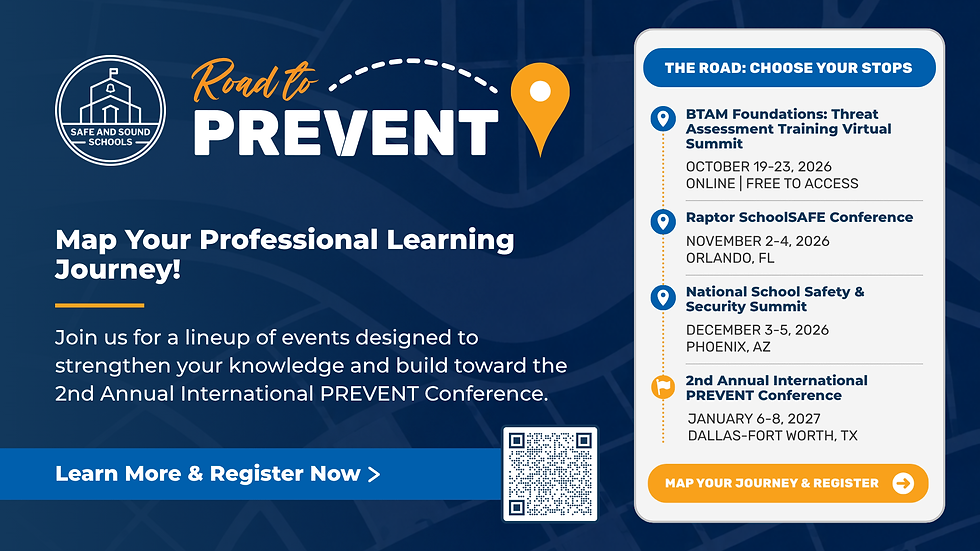
This fall and winter, the Road to Prevent brings together opportunities to do exactly that, with learning experiences designed for professionals at different points in their school safety journey. The series includes virtual and in-person opportunities leading into Prevent, Safe and Sound Schools' advanced behavioral threat assessment training summit, hosted in partnership with Safer Schools Together.
The point is not to check every box or collect another set of professional development hours. The point is to keep moving forward.
If you are just beginning to build a prevention-focused approach, there is a place for you. If your school has been doing this work for years and you are looking for the next opportunity to strengthen your practice, there is a place for you, too.
And if you are somewhere in between, as most of us are, there is plenty to learn.
Learn more and register today to join us along the road.


Comments